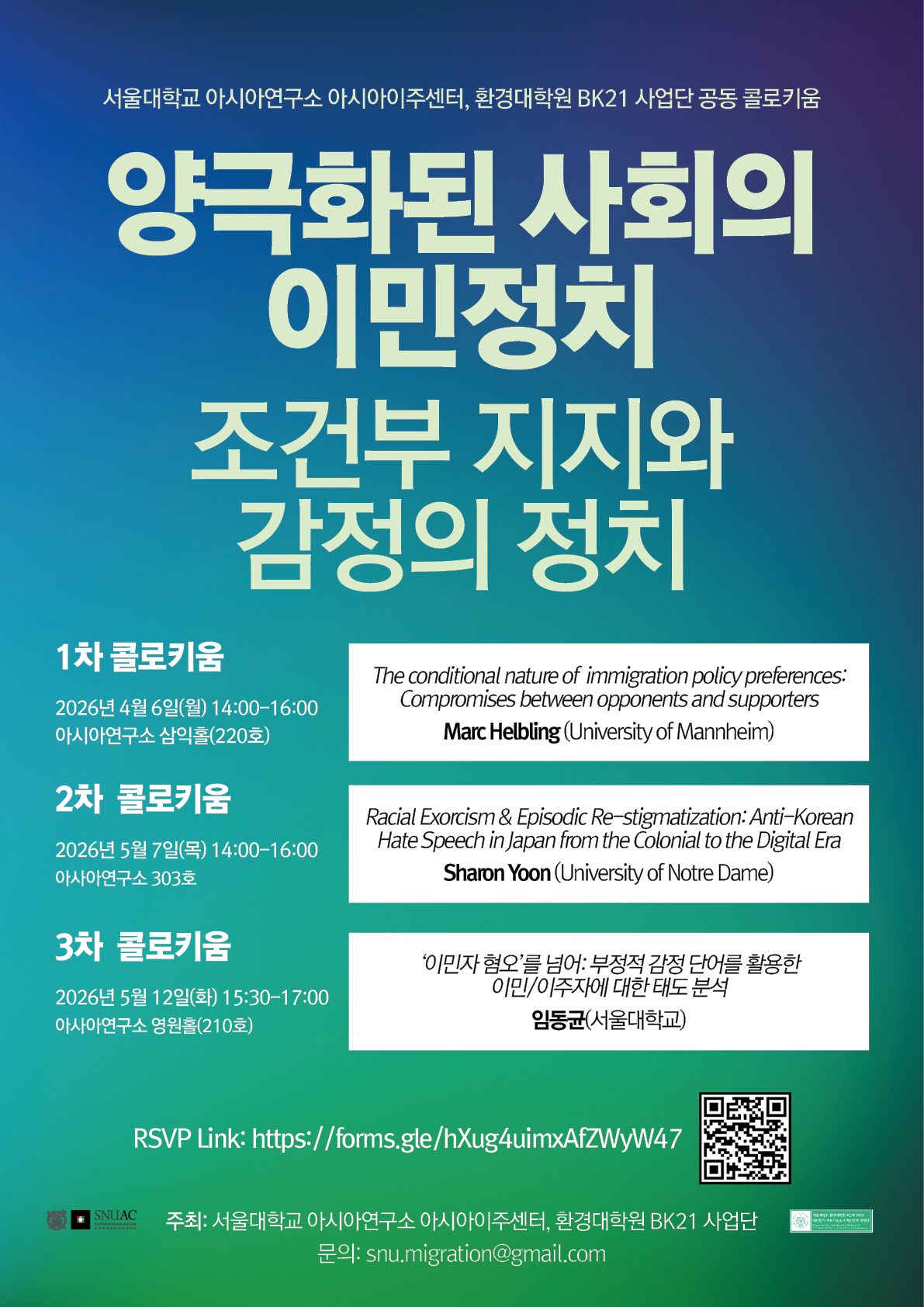
안녕하세요. 아시아연구소 아시아이주센터에서는 2026년 콜로키엄 시리즈 < 양극화된 사회의 이민정치: 조건부 지지와 감정의 정치 >를 준비하였습니다.
이번 콜로키움 시리즈는 전세계적으로 정치적 양극화가 심화되는 가운데, 이민이 좌우 진영을 막론하고 정치적 동원과 공격의 핵심 쟁점으로 부상하고 있는 현실을 반영하여 기획하였습니다. 오늘날 이민은 인구이동이나 제도 설계의 차원을 넘어, 사회적 감정과 정치적 갈등, 공존의 가능성이 복합적으로 교차하는 핵심 의제가 되고 있습니다.
이에 본 시리즈는 데이터에 기반한 정량연구를 통해 이민정책 선호와 이민자에 대한 사회적 태도의 형성 조건을 실증적으로 탐구해 온 연구자를 초청하여, 오늘날 이민을 둘러싼 정치적 담론의 지형을 깊이 있게 살펴보고자 합니다. 이민을 둘러싼 다양한 사회적 태도와 감정이 어떠한 조건과 맥락 속에서 형성되는지를 검토함으로써, 양극화 시대의 이민정치를 보다 입체적으로 이해할 수 있는 계기를 마련하고자 합니다.
서울대 아시아연구소 아시아이주센터는 이번 콜로키움을 통해 보다 성숙한 공론장과 구체적인 사회통합의 방향을 함께 모색하고자 합니다. 많은 참여와 관심 부탁드립니다.
2차 콜로키엄
- 제목: Racial Exorcism & Episodic Re-stigmatization: Anti-Korean Hate Speech in Japan from the Colonial to the Digital Era
- 발표자: Sharon Yoon (University of Notre Dame)
- 일시: 5월 7일(목) 14:00-16:00
- 장소: 아시아연구소 303호
Sharon J. Yoon is associate professor of Korean studies in the Keough School of Global Affairs at the University of Notre Dame. She is affiliated with the Keough School’s Liu Institute for Asia and Asian Studies.
This paper introduces the concept of racial exorcism to analyze the enduring colonial foundations of anti-Korean hate in Japan, focusing on how Zainichi Koreans are rendered hyper-visible and demonized, then symbolically or materially expelled in the name of national purification. Inspired by religious exorcism rituals, racial exorcism functions as a public performance of societal self-cleansing, aimed at restoring the fantasy of a “pure” or “normal” national body. We argue that racial exorcism operates through visibility regimes—institutional and affective structures that determine who becomes visible, and under what conditions. While the underlying logic of these regimes remains consistent, their enactment adapts to shifting historical and technological contexts. We trace these transformations across three techno-social eras in Japan: (1) the colonial era of bureaucratic control, (2) the postwar analog era of proximate violence, and (3) the digital era of platformed hyper-surveillance. Focusing on the racializing chant “Kaere!” [Go back!], we demonstrate how this speech act has long functioned as a core logic of racial exorcism. By linking colonial scripts of domination to contemporary forms of digital hate, “Kaere!” illuminates the continuity of racial governance across eras and the enduring production of Koreans as figures of national anxiety.